An overlooked signal
In early 2025, an intriguing signal emerged on the electric mobility landscape of West Africa.
The Cameroonian government has officially announced its plan to deploy 25,000 electric two-wheelers across the country. This is not a business plan from a startup company, but rather the industrial policy intention of a sovereign state. What's more intriguing is that behind this plan stand two names - one is EDF, and the other is Total Energy.
This is not a coincidence.
Cameroon's plan for 25,000 electric two-wheelers appears to be a national policy for the electrification of transportation. However, when viewed in a broader context, it represents a collective shift in West Africa's industrial policy. Understanding Cameroon is key to grasping the industrial trends in West Africa over the next five years.
01 The numerical password of 25,000 units
What is the significance of 25,000 units in the African electric two-wheeler market?
In 2025, the electric motorcycle market in Africa has grown from less than 1,000 units in 2020 to 70,000 units. 25,000 units is equivalent to 35% of the total market in Africa in 2025. This is not a "pilot project", but a signal of large-scale deployment at the national level.
Cameroon currently has over 5 million registered two-wheelers. Out of this number, 25,000 are electrified, accounting for less than 0.5% - yet it is this "0.5%" that marks the starting point from fuel to electric. More importantly, the electric two-wheeler market in Cameroon itself is expanding rapidly at a double-digit annual growth rate, with a stock of over 100,000 units.
The broader context is that Africa sells about 8 million two-wheelers every year, with an electrification penetration rate of less than 2%. This means that 25,000 units is not an end point, but a starting point - and how high this starting point is depends on who gets the ticket first.
02 The chess game in France - The dual entry of EDF and Total
Who will supply power for 25,000 electric two-wheelers? Who will build charging stations?
EDF and TotalEnergies have already taken their positions in advance.
First, let's talk about EDF. This French state-owned energy giant's presence in Cameroon goes far beyond just "building a few charging piles". EDF's electric mobility strategy in Africa is essentially about exporting the European experience of energy transformation to Africa in a packaged form - including grid transformation, distributed photovoltaics, energy storage systems, and charging networks, forming a complete "energy as a service" solution.
Total's approach is more direct. In 2023, Total and Cameroonian local car dealer 3S Motors jointly established the Cameroon Electric Mobility Promotion Association (Apeme-Cam). The general manager of Total Cameroon put it very bluntly: "This will help maintain the country's purchasing power, make it easier for low-income consumers to acquire new cars, and improve road safety."
Total already has a nationwide network of gas stations in Cameroon. Upgrading this network into a hybrid network of "gas + charging" is the lowest-cost and fastest path to electrification. What EDF needs to do is to solve the problem of "where does the electricity come from" from the grid side.
EDF is responsible for power generation, while Total is in charge of charging - these two French giants have achieved a perfect upstream-downstream division of labor in Cameroon's electric mobility sector.
Why the French? Cameroon was once a French colony, and French is the official language. French companies have deep political and business ties in Cameroon. This is not a simple business decision; it is a continuation of geopolitics.
03 Policy - Cameroon's "carrot and stick" approach
The 25,000 electric two-wheelers were not conjured up with mere words, but were "piled up" through policy tools.
The "Fiscal Law of 2025," which took effect on January 1, 2025, introduced a comprehensive "policy package" for electric mobility:
Tax exemption policy: Electric vehicles are exempt from consumption tax.
50% tax base deduction: Newly imported electric vehicles, motorcycles, batteries, and charging stations will enjoy a 50% deduction of their taxable value within 24 months.
According to the document from the Taxation Bureau of Cameroon's Ministry of Finance, the import tax rate for electric vehicles is only 12.5%. In contrast, import restrictions for used fuel-powered vehicles are being tightened - Cameroon has increased the consumption tax on the import of used vehicles starting from 2026.
A report by the United Nations Environment Programme (UNEP) points out that the average age of second-hand cars imported by Cameroon is as high as 16.2 years, with emissions far exceeding global standards. In July 2024, Cameroon held a national electric mobility seminar supported by UNEP, laying the technical foundation for this series of policies.
This combination of "carrots and sticks" has a very clear objective: to reduce the price of electric vehicles to the level of fuel-powered vehicles, and to increase the cost of second-hand fuel-powered vehicles to a level that consumers dare not buy.
04 Collective shift in industrial policies in West Africa
Cameroon is not an isolated case. Broaden your perspective to West Africa, and you will observe a broader trend.
Nigeria has released the National Electric Vehicle Policy, providing incentives for the manufacturing and import of electric vehicles.
Ghana provides value-added tax and import tariff exemptions for electric vehicles, and is piloting an electric bus assembly plant.
Benin has extended the VAT exemption period for electric mobility-related projects until the end of 2026.
Senegal has incorporated the promotion of electric vehicles into its climate strategy and urban transportation planning.
What the West African countries are doing is essentially a collective "copying homework" - copying Rwanda's homework.
From January 1, 2025, Rwanda will only allow electric motorcycles to be registered for commercial transportation. This policy directly cuts off the future of fuel-powered motorcycles.
Cameroon's plan to deploy 25,000 electric two-wheelers is an acceleration in this "West African electrification race".
Another noteworthy market signal is that in February 2026, after securing a $50 million debt financing led by Afreximbank, Spiro expanded its electric motorcycle fleet to 95,000 units, covering seven African markets, including Cameroon. Spiro currently accounts for approximately 60% of new electric motorcycle sales in Kenya. This means that beyond Cameroon's planned 25,000 units, commercial players are also making efforts simultaneously. The "push" from policy and the "pull" from business are converging.
05 Enlightenment for Chinese Enterprises Going Global
What does Cameroon's plan for 25,000 electric two-wheelers mean for Chinese new energy companies expanding overseas?
Firstly, the policy window period is narrowing.
Cameroon's tax exemption policy only lasts for 24 months. The years 2025 and 2026 represent a golden opportunity to enter the electric two-wheeled vehicle market in Cameroon. After this opportunity passes, it may not come again.
Secondly, French enterprises have obvious first-mover advantages.
EDF and Total have already established a foothold in charging infrastructure and energy supply. If Chinese enterprises only focus on "selling cars", it will be difficult for them to compete with French enterprises that have local political and business connections. The real opportunity lies in the supporting industries of the industrial chain - batteries, motors, electronic controls, and battery swapping cabinets, which are areas that French enterprises do not engage in.
Thirdly, a unified market is taking shape in West Africa.
The customs union and unified market policy of the Economic Community of West African States (ECOWAS) signify that gaining access to the Cameroonian market presents an opportunity to penetrate the entire West Africa. The market volume in Cameroon is 25,000 units, while the entire West Africa market volume is more than ten times this figure.
Fourthly, the battery swapping mode may be the optimal solution.
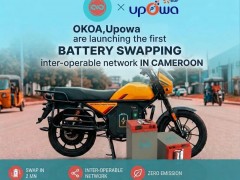
Cameroon currently has only three electric vehicle charging stations. In a market with almost no infrastructure, the battery swapping model is easier to implement than the charging model. Spiro has verified the feasibility of the battery swapping model in Africa.
Conclusion: The industrial ambition behind 25,000 units
Cameroon's plan to introduce 25,000 electric two-wheelers is not an isolated policy, but rather a signal flare indicating a collective shift in industrial policies across West Africa.
EDF and Total's early positioning indicates that the French have understood this card. The tax exemption policy and restrictions on second-hand cars suggest that the Cameroonian government is using its "policy toolbox" to reshape market rules. The synchronized actions of Nigeria, Ghana, Benin, and Senegal indicate that West Africa is forming a unified electric mobility market.
25,000 units represent the first piece of the puzzle for Cameroon's electrification. A larger puzzle is unfolding across West Africa.
For Chinese new energy companies venturing overseas, 2025-2026 is the most crucial time window for laying out the market for electric two-wheeled vehicles in West Africa. The policy incentives have been laid out, and the market pie is growing larger,
There is only one question left: who will be the first to dig in?